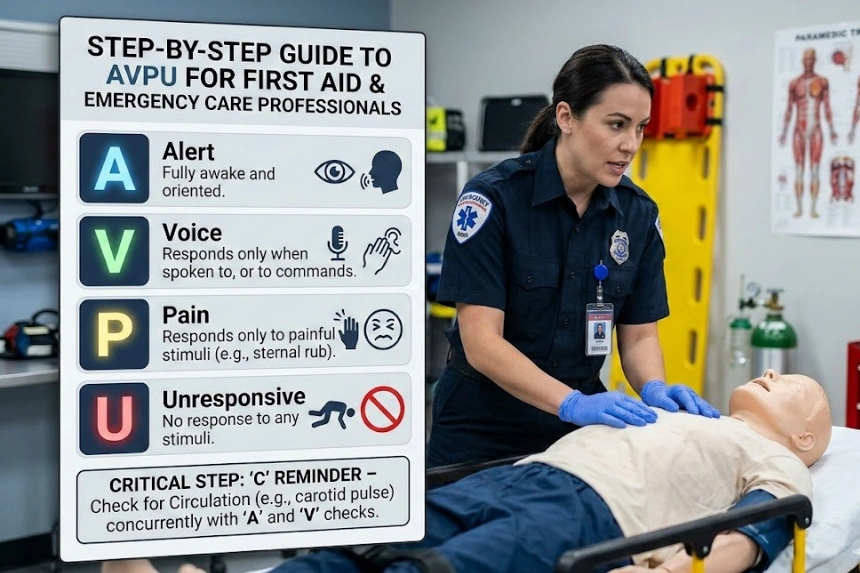
Step-by-Step Guide to ACVPU for First Aid and Emergency Care Professionals
Introduction
The ACVPU scale is an easy way to check how alert someone is. It helps doctors, first responders, and students quickly understand a person’s condition. In this article, we will explain what ACVPU means, how to use it, and give tips for practicing and learning it.
What Is ACVPU?
ACVPU is an acronym used to describe a person’s level of consciousness. It helps responders identify whether someone is fully awake, confused, or unconscious. Each letter in ACVPU stands for a different response:
A – Alert: The person is fully awake and aware of their surroundings. They can respond to questions clearly.
C – Confused: The person is awake but disoriented or unsure about time, place, or situation.
V – Voice: The person does not respond fully but reacts when spoken to.
P – Pain: The person only reacts to a painful stimulus, such as a gentle pinch or pressure on the nail bed.
U – Unresponsive: The person does not respond to voice or pain and may need urgent medical help.
Unlike other scales, like the Glasgow Coma Scale, ACVPU is simpler and faster to use, making it perfect for emergencies.
Why Use ACVPU?
There are several reasons why ACVPU is widely used in first aid and healthcare:
Quick Assessment: It takes only a few seconds to check a patient.
Easy to Remember: The letters are simple, making it easy for anyone to recall in an emergency.
Early Detection of Serious Conditions: Changes in a patient’s level of consciousness can indicate serious health problems like head injuries, strokes, low blood sugar, or infections.
Communication Tool: It provides a common language for healthcare professionals to describe a patient’s condition clearly.
How to Use the ACVPU Scale
Using the ACVPU scale is straightforward. Follow these steps:
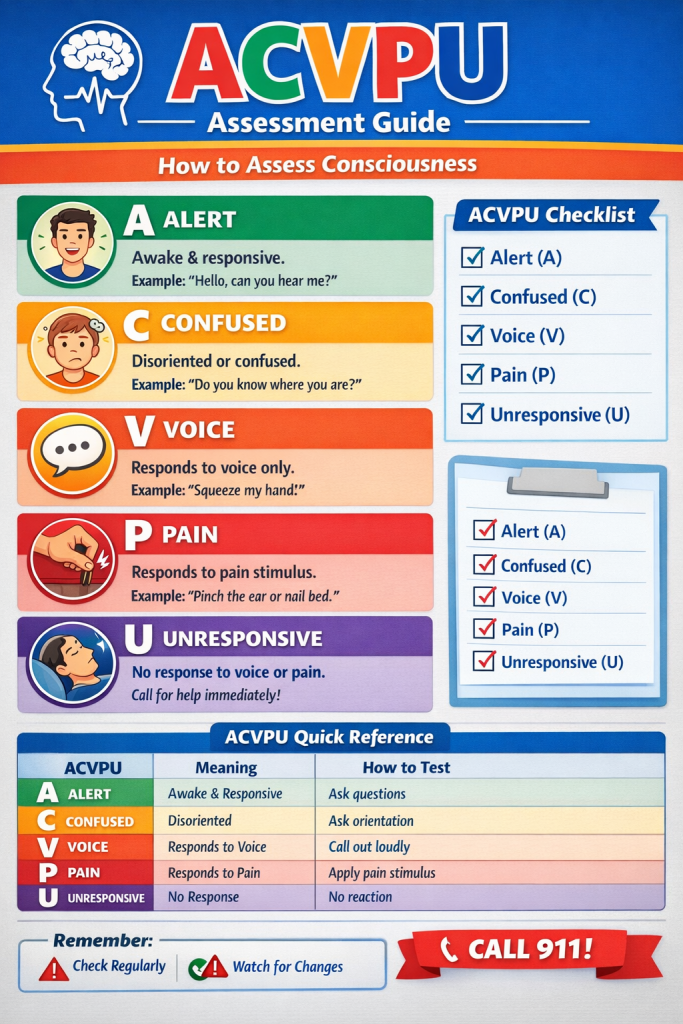
Step 1: Check for Alertness (A)
Begin by approaching the patient safely and speaking to them in a normal tone, such as saying, “Hello, can you hear me?” Observe whether they make eye contact, follow instructions, or respond correctly. If they do, the patient is considered Alert (A). If no problems are found, you can move on to routine checks.
Step 2: Assess Confusion (C)
Next, assess whether the patient is confused by asking simple orientation questions, like “What is your name?”, “Do you know where you are?”, and “What day is it today?” If they answer incorrectly or seem disoriented, they should be marked as Confused (C).
Step 3: Test Response to Voice (V)
If the person does not respond normally, try speaking loudly or clearly, for example, asking, “Can you squeeze my hand?” If the patient responds only to your voice, they are classified as V – Voice.
Step 4: Apply Gentle Pain Stimulus (P)
When there is no response to voice, apply a gentle and safe pain stimulus, such as pinching the earlobe or the base of the nail bed, taking care to avoid causing injury. If the patient reacts only to this pain, they are considered P – Pain.
Step 5: Check for Unresponsiveness (U)
Finally, if there is no reaction to voice or pain, the patient is Unresponsive (U). This is a medical emergency, and professional help should be called immediately.
Practical Tips for ACVPU Assessment
Stay Calm: Patients may respond differently depending on anxiety, fear, or injury.
Observe Carefully: Sometimes subtle movements, like blinking or small gestures, are the only response.
Record Findings: Always note the letter (A, C, V, P, U) in the patient’s chart or handover report.
Check Regularly: In critical patients, repeat ACVPU checks every 5-10 minutes.
ACVPU vs. Other Scales
The Glasgow Coma Scale (GCS) is more detailed but can be complicated for beginners. Here’s why ACVPU is often preferred for initial assessment:
| Feature | ACVPU | Glasgow Coma Scale (GCS) |
|---|---|---|
| Ease of Use | Very simple | More complex |
| Time to Assess | < 1 minute | Several minutes |
| Ideal for Beginners | Yes | No |
| Detailed Score | No | Yes |
| Emergency Situations | Yes | Yes |
ACVPU gives a fast snapshot of consciousness, while GCS provides a numerical score useful in hospitals. For most first aid and emergency situations, ACVPU is sufficient.
Common Scenarios for ACVPU Use
Head Injuries: Quickly determine if someone is losing consciousness.
Medical Emergencies: Such as strokes, seizures, or diabetic emergencies.
Emergency Services: Ambulance crews and paramedics use ACVPU as part of triage.
Schools and Workplaces: First-aid-trained staff can use it to assess fainting or accidents.
Tips for Practice and Training
To become proficient with ACVPU, practice regularly:
Use Roleplay: Have classmates or colleagues simulate different responses (alert, confused, voice-only).
Create a Checklist: Include each step (A → C → V → P → U) to ensure nothing is missed.
Printable Poster: A visual chart with the ACVPU steps can help during training or in classrooms.
Record Timings: Practicing with a timer helps you assess patients quickly in emergencies.
Combine With Vital Signs: Monitor pulse, breathing, and skin color alongside ACVPU.
Red Flags to Watch For
Changes in a patient’s level of consciousness can signal serious medical problems and require immediate attention. Be particularly alert if someone suddenly drops from being fully alert to confused or only responding to voice.
If a patient who was previously responsive shows no reaction to pain, this is a critical warning sign. Seizures or unusual movements combined with alterations in ACVPU levels should also raise concern.
Additionally, signs such as unequal pupils, slurred speech, or difficulty breathing alongside a change in consciousness indicate a potentially life-threatening situation. In any of these cases, urgent medical intervention is essential.
ACVPU Quick Reference Table
| ACVPU | Meaning | How to Test |
|---|---|---|
| A | Alert | Speak normally, ask questions |
| C | Confused | Ask orientation questions |
| V | Voice | Speak loudly, observe response |
| P | Pain | Apply gentle, safe pain stimulus |
| U | Unresponsive | No response to voice or pain |
Conclusion
The ACVPU scale is an essential tool for assessing consciousness. Its simplicity, speed, and effectiveness make it perfect for first aid, emergency care, and classroom learning. By practicing regularly, using checklists, and combining it with vital signs, anyone can become confident in evaluating patients quickly and accurately.