Electrostatic Pumps Explained: Benefits and Applications Across Sectors
Introduction
Electrostatic pumps use electric charges to improve how liquids like paint, pesticides, and disinfectants are sprayed. By charging tiny droplets, these pumps ensure better coverage, reduce waste, and increase efficiency across industries such as automotive painting, agriculture, healthcare, and printing. This article explores how electrostatic pumps work, their benefits, applications, and what to consider when choosing one.
What Is an Electrostatic Pump?
An electrostatic pump is a device that moves liquid, like paint, pesticide, or disinfectant, and gives it an electric charge as it comes out. That charge is what makes this pump special.
Think of it like rubbing a balloon on your hair. After you rub it, the balloon sticks to a wall because of static electricity. An electrostatic pump works in a similar way. It charges tiny droplets of liquid so they are attracted to a surface, just like that balloon sticks to the wall.
Regular pumps just spray liquid everywhere. Electrostatic pumps spray smarter. The charged droplets wrap around objects and stick to them evenly, which saves material, reduces waste, and gives much better coverage.
Step-by-Step Working of an Electrostatic Pump
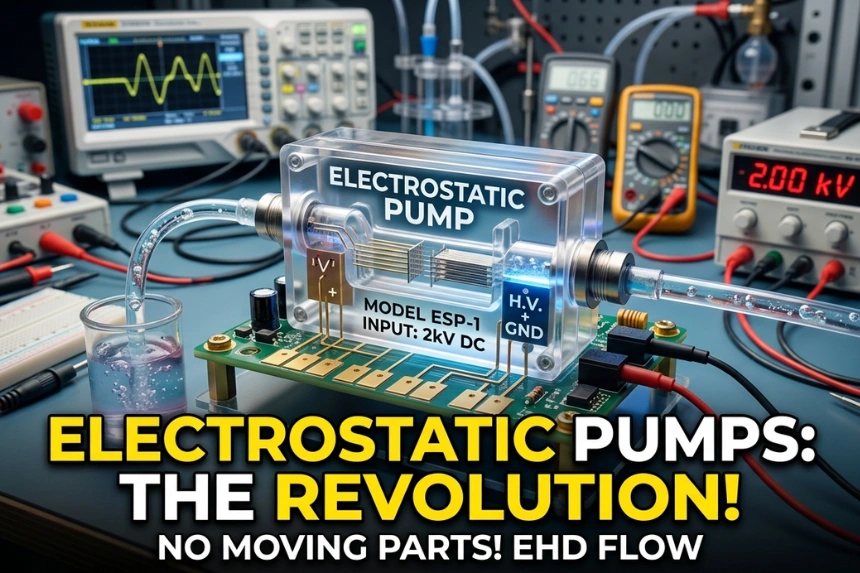
An electrostatic pump (EHD pump) moves fluid using electric forces instead of mechanical parts. Here is its working process in a simple, step-by-step way:
Step 1: Power is supplied
The pump is connected to a high-voltage power source. This electricity is needed to create an electric field inside the pump.
Step 2: Electric field is created
Inside the pump, two electrodes generate an electric field. This field is like an invisible force that can push or pull charged particles.
Step 3: Fluid gets charged
The working fluid (liquid or gas) becomes ionized or electrically charged. This means tiny particles in the fluid gain either a positive or negative charge.
Step 4: Charged particles start moving
Positive and negative particles are attracted to opposite electrodes. They begin to move in a specific direction because of the electric field.
Step 5: Fluid is dragged along
As charged particles move, they pull surrounding neutral fluid molecules with them. This creates a smooth flow of the entire fluid.
Step 6: Continuous pumping happens
As long as electricity is supplied, the electric field keeps pushing charged particles, and the fluid continues to flow steadily through the pump.
Where Are Electrostatic Pumps Used?
You’d be surprised how many places this technology shows up in everyday life. Here are some of the most common uses:
1. Painting and Coating
Car manufacturers and factories use electrostatic pumps to paint metal parts. The charged paint wraps around the entire piece, even hard-to-reach corners and edges, giving it a smooth, professional finish. It also means less paint is wasted compared to regular spray painting.
2. Farming and Agriculture
Farmers use electrostatic sprayers to apply pesticides or fertilizers to crops. Because the droplets are attracted to the leaves and stems of plants, the liquid coats all sides of the plant, not just the top. This means fewer chemicals are needed, which is better for the environment and costs less money.
3. Cleaning and Disinfecting
After the COVID-19 pandemic, many schools, hospitals, and businesses started using electrostatic sprayers to disinfect rooms quickly and thoroughly. The charged disinfectant wraps around chairs, desks, and surfaces, covering every angle without having to wipe everything by hand.
4. Printing Industry
Some types of industrial printers use electrostatic technology to control how ink is placed on paper or other materials. This allows for very precise and clean printing results.
What Are the Benefits of an Electrostatic Pump?
So why would someone choose an electrostatic pump over a regular one? There are some great reasons:
Less waste: Because the droplets are attracted to the surface, very little liquid ends up in the air or on the ground. You use less product overall.
Better coverage: Regular sprayers only hit the surfaces they’re pointed at. Electrostatic pumps wrap around the whole object, including the back and sides, which means nothing gets missed.
Saves time: You don’t have to go over the same spot multiple times. One pass gives a more complete coat.
Environmentally friendly: Using less chemical or paint means less pollution and less harm to the environment.
Cost-effective: Even though electrostatic pumps can cost more upfront, they save money over time by using less product.
Are There Any Downsides?
Like anything, electrostatic pumps have a few drawbacks too. It’s only fair to mention them:
- Higher upfront cost: These pumps are more expensive than basic sprayers, which might be a challenge for small businesses or individual users.
- Needs electricity: Because they use electric charges, they need a power source. This makes them less ideal for areas without reliable electricity.
- Not all liquids work well: Some liquids don’t take an electric charge easily, so electrostatic pumps aren’t suitable for every type of job.
- Training required: Users need to understand how the technology works to get the best results and to stay safe around electrical components.
How Is an Electrostatic Pump Different from a Regular Spray Pump?
A regular spray pump just pushes liquid out through a nozzle. The droplets go where you point the nozzle and fall due to gravity. There’s no attraction to the surface. A lot of liquid bounces off, drifts away in the air, or misses its target completely.
An electrostatic pump, on the other hand, adds a charge to those droplets. That charge creates a pulling force between the droplet and the surface — almost like a magnet. So instead of bouncing off or drifting, the droplets stick right where they need to go. The result is less waste and better coverage, every single time.
A regular pump is like throwing a handful of confetti, it goes everywhere. An electrostatic pump is like throwing confetti that’s magnetized to one spot. Much more effective!
What Should You Look for When Choosing an Electrostatic Pump?
If you or someone you know is thinking about getting an electrostatic pump, here are a few things worth considering:
What will it be used for? Different jobs need different types. Farming, painting, and disinfecting all have specific needs.
Tank size: A larger tank means you can spray longer without refilling, which is helpful for big areas.
Battery or corded? Battery-powered models are easier to move around. Corded ones have more consistent power.
Adjustable settings: A pump with adjustable spray patterns and charge levels gives you more control over the job.
Ease of cleaning: Look for pumps that are easy to rinse out after use. Leftover liquid inside the tank can clog the nozzle over time.
Electrostatic Pump Pricing
| Type | USD (approx.) | GBP (approx.) |
| Entry-level / Home use | $45 – $100 | £35 – £80 |
| Mid-range / Professional | $500 – $1,200 | £400 – £950 |
| Commercial / Industrial | $1,500 – $5,000+ | £1,200 – £4,000+ |
Fun Fact: The Science Behind It
The science behind electrostatic pumps has been around for a long time. In fact, the idea of using static electricity to move particles goes back to experiments by scientists in the 1700s and 1800s. But it wasn’t until the 20th century that engineers figured out how to use this idea in practical tools like sprayers and pumps.
Today, the technology has become much more advanced and affordable. What used to be only available in large factories is now available to farmers, janitors, business owners, and even some homeowners.
Final Thoughts
An electrostatic pump might sound complicated, but the idea is pretty simple: use electricity to make liquid droplets stick better to surfaces. This leads to less waste, better coverage, and smarter spraying, whether you’re painting a car, protecting a crop, or disinfecting a classroom.
As technology keeps improving, electrostatic pumps are becoming more common and more affordable. Whether you’re a student learning about engineering, a farmer looking for better tools, or just a curious reader, understanding how this technology works helps you see the smart science hiding in everyday tools all around us