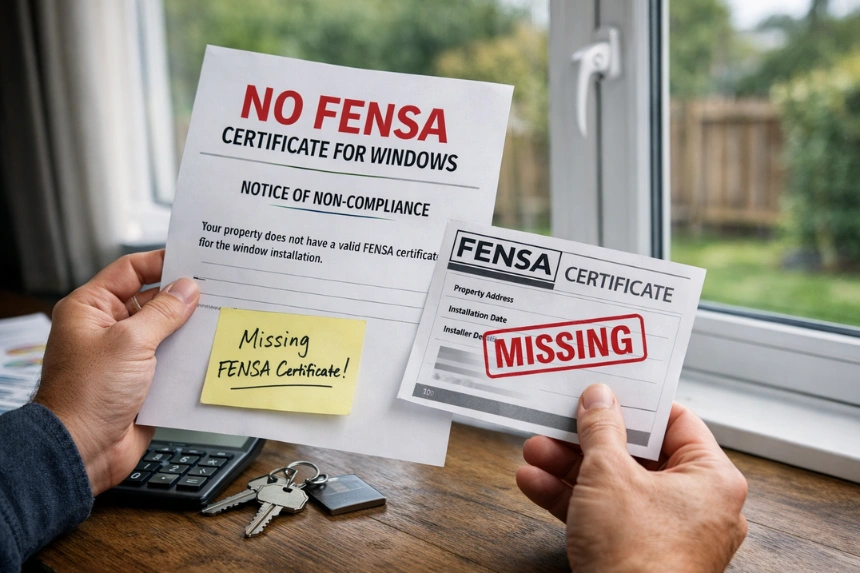
How to Handle No FENSA Certificate for Windows During Property Sales
Introduction
Finding out there is no FENSA certificate for windows can feel stressful, especially when you are buying or selling a home. Many people only hear about FENSA when a solicitor asks for the paperwork. At that point, confusion starts. Is it a legal problem? Can the sale still go ahead? How much will it cost to fix?
The good news is that this problem can usually be dealt with. But it is important to understand what the missing certificate really means, what your options are, and what each option does and does not protect you against.
This guide explains everything in simple words. It covers how to get a no FENSA certificate for windows issue sorted out, the likely no FENSA certificate for windows cost, and whether no FENSA certificate for windows indemnity is really enough.
What Is a FENSA Certificate?
A FENSA certificate is proof that replacement windows or doors were installed in line with Building Regulations in England and Wales.
FENSA stands for the Fenestration Self-Assessment Scheme. It is a government-authorised scheme. When a FENSA-registered installer replaces windows or doors, they can confirm that the work meets the rules without the homeowner needing to apply separately to the local council. After the job is completed, the installer registers the work and the homeowner receives a FENSA certificate.
This certificate matters because it shows the installation met legal standards for things like energy efficiency, safety, ventilation, and escape access.
What Does “No FENSA Certificate for Windows” Mean?
When people say there is no FENSA certificate for windows, they usually mean one of these things.
The windows were installed by someone who was not FENSA-registered. The work may have been done without telling Building Control. The certificate may have been lost. Or the work was carried out years ago and nobody kept the paperwork.
This is where many homeowners become confusee no FENSA certificate for windows situations. They may not know whether the issue is a missing document or whether the work was never approved in the first place.
That difference matters.
If the work was originally registered, getting a replacement certificate is usually simple. But if the work was never registered, then you may need to fix the problem in a different way.
Can You Sell a House Without a FENSA Certificate?
You may still be able to sell, but the missing certificate will almost always be raised during conveyancing.
A buyer’s solicitor will usually ask for proof that the windows comply with Building Regulations. If you cannot provide a FENSA certificate or a Building Control certificate, the buyer may ask you to sort it out before the sale goes through.
This can delay the sale. In some cases, it can even cause the sale to fall through if the issue is not resolved.
That is why it is best to deal with the problem early instead of waiting until the last minute.
How to Get a No FENSA Certificate for Windows Problem Sorted
If you are wondering how to get a no FENSA certificate for windows issue fixed, there are three main routes.
The first is to get a replacement certificate if the work was originally registered.
The second is to get retrospective approval through Building Control or through a FENSA-registered installer who can inspect the work.
The third is to use indemnity insurance if certification is not practical and the buyer is willing to accept that route.
Let’s look at each option clearly.
Option 1: Get a Replacement FENSA Certificate
This is the easiest solution, but it only works if the original installer was FENSA-registered and the work was properly recorded at the time.
If that happened, you can usually apply for a duplicate certificate. The fee is often around £25.
This is the best outcome because it gives you the correct paperwork without needing further inspections or legal work. If you think the windows were fitted by a FENSA company, check first before spending money on other options.
Option 2: Apply for Retrospective Building Control Approval
If there was never any certificate, you can contact your local council and ask about retrospective Building Regulations approval. This is often called regularisation.
The council will inspect the windows to see if the work meets the required standards. If everything is acceptable, they can issue a certificate. If problems are found, you may need to carry out extra work before approval is given.
The usual no FENSA certificate for windows cost for this route is often around £300 to £400, although it can be more depending on the local authority and the job itself.
This option takes more time than getting a replacement certificate, but it gives official proof of compliance. That makes it a strong solution, especially if you want proper paperwork rather than a temporary fix.
Option 3: Retrospective FENSA Certification
In some cases, a FENSA-registered installer may inspect the existing windows and assess whether they meet the rules. If they do, and if any needed changes are made, the work may be certified retrospectively.
For example, the installer may check safety glazing, ventilation, fire escape requirements, and other technical points. If trickle vents or other updates are needed, those may have to be installed first.
The price for this option can vary because it depends on the installer’s survey fee and any repair or upgrade work needed.
This route can be useful if you want a FENSA-style solution, but it is not always as simple as ordering a duplicate certificate.
Option 4: Indemnity Insurance
The last common option is no FENSA certificate for windows indemnity insurance.
This is often used during property sales because it can be arranged quickly. The policy usually protects the buyer and lender against certain financial losses if the local authority later takes enforcement action over the missing certification.
Typical premiums are often around £180 to £500, depending on the value of the property and the insurer.
At first glance, indemnity insurance can sound like the perfect answer. It is fast, fairly common, and may help a sale move forward. But it is very important to understand what it does not do.
What Indemnity Insurance Does Not Cover
Indemnity insurance does not prove that the windows meet Building Regulations.
It does not confirm that the installation is safe.
It does not fix poor workmanship.
It does not cover fines, unsafe glass, energy loss, or future repair work that may be needed.
This is why indemnity insurance should not be confused with proper certification. It protects against a limited financial risk, but it does not solve the real issue behind the missing paperwork.
So, if you are comparing your options, remember this simple rule: a certificate proves compliance, while indemnity only covers certain risks linked to missing proof.
Which Option Is Best?
The best option depends on your situation.
If the work was already registered, a replacement certificate is clearly the best and cheapest answer.
If the work was never registered and you want proper proof, retrospective approval through Building Control or a FENSA installer is often the strongest route.
If you are in the middle of a sale and need a faster short-term solution, indemnity insurance may help, but it should be seen as a practical workaround rather than a full fix.
In many cases, homeowners choose the quickest option because they want the sale to continue. But long term, proper certification gives more peace of mind.
Risks of Leaving the Problem
Ignoring the issue can cause problems later.
You may face delays when selling the property. Buyers may ask questions, lenders may become cautious, and solicitors may insist on extra checks. The lack of paperwork can also make people wonder whether the installation itself was done properly.
There is also a small but real risk of local authority enforcement if the work is found to be non-compliant. In some situations, homeowners may be told to correct or replace the windows.
Another problem is that uncertified windows may not meet current safety or energy standards. So even if the missing certificate feels like “just paperwork,” it can sometimes point to a real installation problem underneath.
A Simple Step-by-Step Plan
If you discover there is no certificate, start by finding out who installed the windows and when the work was done. If the installer was FENSA-registered, check whether a replacement certificate can be ordered.
If that is not possible, speak to your local council about retrospective approval and also ask a FENSA-registered installer whether they offer compliance inspections for existing windows.
If you are selling and time is tight, talk to your solicitor about indemnity insurance, but make sure you understand its limits before relying on it.
Final Thoughts
A no FENSA certificate for windows issue is common, but it should not be ignored. The missing certificate can create legal, practical, and financial problems, especially during a house sale. Still, it is usually a problem with a solution.
The main thing is to understand the difference between proof of compliance and insurance against risk. A replacement or retrospective certificate gives you stronger protection. Indemnity insurance may help in some cases, but it does not make the windows compliant.
If you deal with the issue early, keep good records, and choose the right route for your situation, you can avoid much bigger problems later.
FAQs
If the original installer was FENSA-registered and the work was recorded, you can usually apply for a duplicate certificate for around £25.
It depends on the solution. A replacement certificate is usually about £25. Retrospective Building Control approval is often around £300 to £400. Indemnity insurance is commonly around £180 to £500.
It may be enough for some property sales, but it does not prove the windows are compliant or safe. It only protects against certain financial losses.
If they were installed in England or Wales after 1 April 2002, they should have either a FENSA certificate or a Building Control completion certificate.
Yes. If the windows were installed before the rules changed in April 2002, a FENSA certificate may not exist, and that is a different situation.