Understanding the Honda 72147-3A0-A01 Smart Key Fob Features and Compatibility
Losing or damaging a key fob for a modern Honda can be a surprisingly involved experience. Unlike older mechanical keys, today’s proximity smart keys are paired to your vehicle’s computer and require professional programming to function. If you own a 2023–2025 Honda CR-V, Pilot, or HR-V, the part number you need to know is 72147-3A0-A01, the OEM keyless entry remote (key fob transmitter) used across several of Honda’s most popular current models.
This guide covers everything you need to know about the 72147-3A0-A01: what it is, which vehicles it fits, its full technical specifications, how programming works, your replacement options, and how to keep costs manageable.
What Is the 72147-3A0-A01?
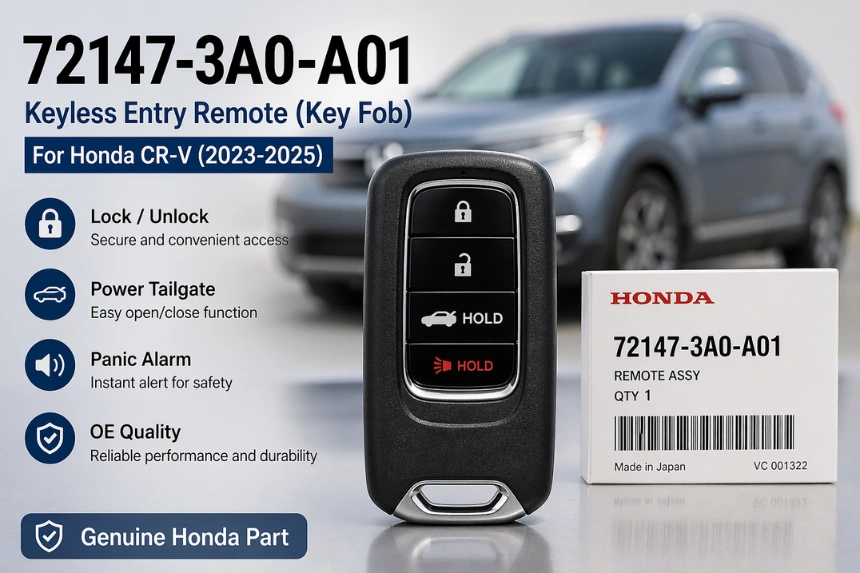
The 72147-3A0-A01 is a five-button proximity smart key fob manufactured for Honda. It serves as the keyless entry remote and push-start transmitter for compatible vehicles, enabling drivers to lock, unlock, open the rear hatch, trigger the panic alarm, and activate remote start — all without physically inserting a key.
As a proximity key, the 72147-3A0-A01 uses passive entry technology: when the fob is within a defined range of the vehicle, the door handles become active, allowing entry without pressing any buttons. The push-button start function similarly recognises the fob’s presence before allowing the engine to start.
The FCC identification number associated with this fob is KR5TP-4, which is the code registered with the US Federal Communications Commission for the transmitter module. You may also encounter the closely related part number 72147-3A0-A11, which represents the Driver 2 memory slot version of the same fob, both share the same physical design and electronics.
Compatible Vehicles
The 72147-3A0-A01 is confirmed compatible with the following Honda models and model years:
- Honda CR-V — 2023, 2024, 2025
- Honda Pilot — 2023, 2024
- Honda HR-V — 2023, 2024, 2025
These vehicles use Honda’s current-generation push-button start system. The fob is only compatible with vehicles equipped with a push-start button — it will not function as a replacement in older Honda models that use a conventional ignition key.
If you are unsure whether your vehicle uses this part number, the most reliable method is to check the FCC ID or part number printed on the back of your existing fob. If that is unavailable, your VIN can be used to confirm the correct part at a dealership or through a reputable automotive parts supplier.
Full Technical Specifications
| Specification | Detail |
| Part Number | 72147-3A0-A01 |
| Related Part Number | 72147-3A0-A11 (Driver 2) |
| FCC ID | KR5TP-4 |
| Continental Part Number | A3C0775510100 / A3C0775520100 |
| Buttons | 5 (Lock, Unlock, Hatch, Panic, Remote Start) |
| Frequency | 433 MHz |
| Transponder Chip | Philips ID 47 (4A/Hitag AES) |
| Battery | CR2032 |
| Programming Method | Scan tool required (dealer or locksmith) |
| Key Type | Proximity Smart Key (Push-Start compatible only) |
Understanding the Five Buttons
The 72147-3A0-A01 includes five functional buttons, each serving a distinct purpose:
Lock: Secures all doors and the rear hatch remotely. A double-press on some configurations activates the horn chirp confirmation.
Unlock: Releases all door locks. A single press typically unlocks the driver’s door; a second press may unlock all doors depending on vehicle settings.
Hatch: Opens the rear power tailgate (where equipped), providing hands-free access to the boot without requiring the key to be presented to the hatch sensor.
Panic: Triggers the vehicle’s alarm horn and hazard lights, useful in emergencies or for locating the vehicle in a car park.
Remote Start: Starts the engine from a distance, allowing the interior to pre-condition before entry. This feature is particularly useful in cold or hot climates.
How Programming Works
The 72147-3A0-A01 cannot be self-programmed. Unlike some older Honda key fobs that used onboard programming sequences, this proximity smart key requires a scan tool to pair it to the vehicle’s immobiliser and keyless entry module. This means professional programming — either at a Honda dealership or with a qualified automotive locksmith equipped with the appropriate diagnostic equipment, is mandatory.
The process itself is straightforward once the fob is in the hands of a professional. The technician connects a scan tool to the vehicle’s OBD-II port, accesses the immobiliser programming menu, and registers the new fob to the car’s memory. Most vehicles can hold multiple fob registrations, which is why the -A01 and -A11 suffixes represent Driver 1 and Driver 2 memory slots respectively.
If your vehicle previously had two registered fobs and you are replacing one, it is important to inform the technician so they can program the new fob into the correct memory slot without overwriting the remaining original.
Replacement Options: OEM, Refurbished, and Aftermarket
When sourcing a replacement 72147-3A0-A01, you have three main routes. Each carries different cost and quality implications.
1. New OEM
A brand-new, factory-original Honda fob sourced through a Honda dealership or OEM parts supplier. This is the highest-cost option but offers complete confidence in compatibility, materials, and durability. Dealership pricing for a complete OEM smart key replacement — including programming, typically ranges from £150 to £350 depending on location and whether labour is included.
2. Refurbished OEM
Factory-original fob electronics in a reconditioned casing. Refurbished OEM units retain the original circuit board and transponder chip, ensuring full compatibility, while the exterior casing may be replaced. These units are typically sold by specialist automotive key suppliers and represent a cost-effective middle ground. A refurbished 72147-3A0-A01 generally ships with a new battery, a new uncut emergency insert key, and a warranty.
3. New Aftermarket
Premium aftermarket fobs are available from manufacturers like Alliskeys and similar brands, sold through platforms such as Amazon. These are not Honda OEM products but are designed to match the specifications of the 72147-3A0-A01, same FCC ID, same frequency, same chip type. Aftermarket fobs significantly reduce the upfront cost of the physical unit, though programming fees still apply. Quality varies between manufacturers, so purchasing from established sellers with pre-tested units and a return policy is advisable.
The general guidance for newer vehicles with complex security systems is that OEM or refurbished OEM units offer the most reliable long-term experience. Aftermarket options can work well when sourced carefully, but compatibility should always be confirmed before purchase.
Cost Breakdown: What to Expect
The total cost of replacing a 72147-3A0-A01 involves two components: the fob itself, and the programming fee.
Fob cost:
- OEM new: typically £80–£150+ for the unit alone
- Refurbished OEM: typically £40–£80
- Aftermarket: typically £20–£50
Programming cost:
- Honda dealership: typically £60–£150 for programming (often bundled with the key purchase)
- Automotive locksmith: typically £40–£80 for programming only
Total typical range:
- Dealership (OEM, all-in): £150–£350+
- Locksmith + aftermarket fob: £60–£130
An automotive locksmith is generally the most cost-efficient route when you have already sourced the fob independently. Locksmiths with mobile services can also attend your location, which is practical if the vehicle cannot be driven without a functioning key. When comparing providers, confirm that the locksmith has the equipment required to programme Honda’s current-generation proximity keys before committing.
Battery Replacement and Maintenance
The 72147-3A0-A01 uses a CR2032 coin cell battery, which is widely available from most supermarkets, electronics retailers, and automotive parts shops. Battery life typically ranges from two to three years under normal use conditions, though this varies with usage frequency and climate.
Signs that the battery requires replacement include reduced range (having to be physically closer to the vehicle for the fob to respond), inconsistent button response, or a low battery warning on the vehicle’s instrument cluster. Replacing the battery is a straightforward process that does not require reprogramming, the fob retains its pairing with the vehicle regardless of battery changes.
Summary
The 72147-3A0-A01 is the proximity smart key fob used in the Honda CR-V, Pilot, and HR-V across the 2023–2025 model years. With five buttons, a 433 MHz transmission frequency, a Philips ID 47 transponder chip, and FCC ID KR5TP-4, it is a fully integrated keyless entry and push-start remote that requires professional scan-tool programming to activate.
Whether you are replacing a lost fob, sourcing a spare, or simply researching your options, understanding the part number, compatibility, and cost landscape helps you make a confident, cost-effective decision. Purchasing from a verified source and using a qualified locksmith or dealership for programming ensures the replacement fob performs exactly as the factory original.
Frequently Asked Questions About the 72147-3A0-A01
This fob is confirmed compatible with the Honda CR-V (2023–2025), Honda Pilot (2023–2024), and Honda HR-V (2023–2025). Always verify using the FCC ID (KR5TP-4) on your existing fob or by providing your VIN to a parts supplier.
The -A01 suffix designates the Driver 1 memory position, and the -A11 suffix designates Driver 2. Both fobs are functionally identical in terms of electronics and physical design. The distinction matters only during programming, where each fob is assigned to a specific driver memory slot in the vehicle’s system.
No. This fob requires a professional scan tool for programming and is not compatible with any onboard DIY programming sequence. A Honda dealership or automotive locksmith with appropriate equipment must complete the programming.
Yes. The 72147-3A0-A01 includes an integrated emergency key blade, which must be cut to match your vehicle’s door and ignition locks. This cutting is typically performed by the same dealer or locksmith completing the programming.
Aftermarket fobs from reputable suppliers that share the same FCC ID and chip specifications can work reliably. However, for 2023+ Honda models with advanced security systems, OEM or refurbished OEM units are generally the lower-risk choice if long-term compatibility and performance are priorities.
The fob uses a CR2032 lithium coin cell battery. Replacement is straightforward and does not affect the fob’s programming.