SPeters Training System: Redefining Modern Dressage Coaching
Introduction
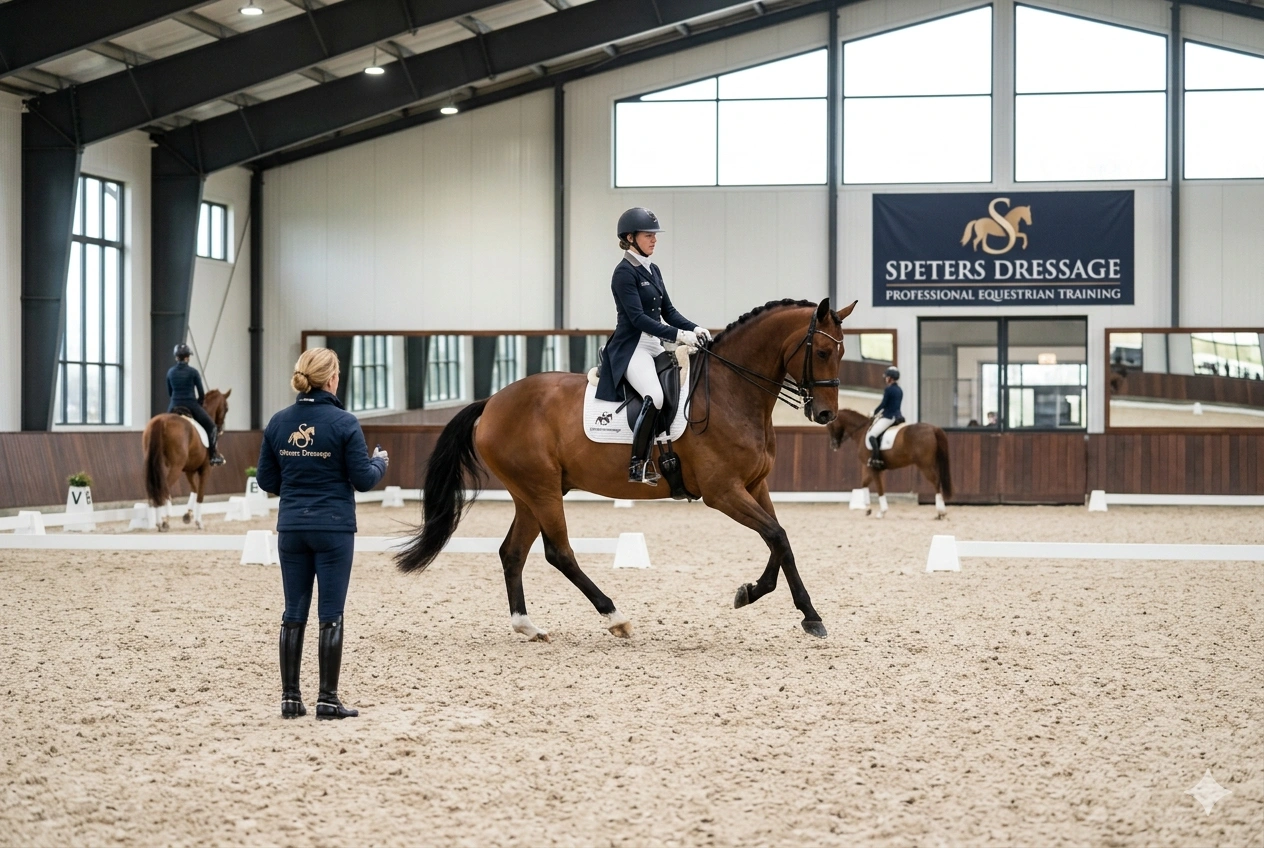
In the world of professional horse riding and dressage coaching, few names carry the weight that SPeters does. Based at the Arroyo Del Mar facility in San Diego, California, SPeters Dressage is the equestrian training business built around six-time Olympic athlete Steffen Peters and his wife Shannon Peters, a USDF Gold Medalist and accomplished Grand Prix dressage rider in her own right. Together, they have created one of the most respected coaching environments in dressage, one that has shaped the careers of numerous competitive riders and horses across the FEI levels.
The Origins of SPeters
The story of SPeters begins long before the business had a name. Steffen Peters grew up in Wesel, Germany, and began riding at the age of seven. By his mid-teens he was competing across Belgium and Denmark, and at sixteen his father gave him a three-year-old KWPN gelding named Udon, a horse that would eventually carry him to team bronze at the 1996 Atlanta Olympics.
A pivotal shift came in the summer of 1984, when Steffen spent time training in San Diego under American trainer Laurie Falvo. After completing his army service in Germany, he returned to the United States in 1985 and made the definitive choice to build his life and career there. He became a US citizen in 1992, opened his own barn in 1991, and began his Grand Prix career in international competition in 1993.
Shannon Peters, then Shannon Allen, built a successful training business in Colorado before relocating to San Diego following her marriage to Steffen in 2003. In 2006, the couple moved their combined operation to Arroyo Del Mar, where SPeters Dressage has been based ever since. While Steffen and Shannon each run their training businesses separately, with distinct client rosters and horses, they share the same facility, training philosophies, and the experienced team that has become a defining characteristic of the SPeters identity.
Steffen Peters: The Competitive Record That Defines the Programme
The credibility of any high-level coaching business is inseparable from the competitive record of those delivering the instruction. In Steffen’s case, that record is exceptional by any measure.
He has represented the United States across six Olympic Games, earning team bronze medals at Atlanta 1996 and Rio de Janeiro 2016, and team silver at the Tokyo 2020 Games. His international honours extend across five FEI World Championships, two Pan American Games gold medals, and two World Cup Final victories. He was named USEF Equestrian of the Year three times, in 2008, 2009, and 2011, and his partnership with the KWPN gelding Ravel produced over 40 Grand Prix wins before Ravel’s retirement in 2012 and subsequent induction into the United States Dressage Federation Hall of Fame.
More recently, his partnership with Suppenkasper, affectionately nicknamed Mopsie, brought a new generation of audiences to the sport. Their Grand Prix Freestyle performance at the Tokyo Olympics set to pulsating dance music generated over 70 million Google searches, briefly making dressage a mainstream cultural conversation.
This uninterrupted record of high-performance competition, spanning decades and multiple horses, is the foundation on which SPeters Dressage coaching rests. Steffen’s ability to develop horses from young prospects to Grand Prix competitors and to sustain those relationships at the top of the sport.
Shannon Peters and Her Contribution to Team SPeters
SPeters Dressage is not simply Steffen’s operation. Shannon Peters is a formidable equestrian professional in her own right and an integral part of what makes the facility distinctive.
A USDF Gold Medalist, Shannon has competed in USDF-recognized shows on 41 different horses and has accumulated 133 shows as a CLS five-star competitor. She has developed fifteen horses from training level to Grand Prix dressage, a considerable achievement in its own right, and has done so with all of them barefoot, a commitment to hoof health and long-term soundness that has attracted attention across the equestrian press.
Her longtime mentor, Karl Mikolka, instilled a belief that understanding the horse as a willing partner requires dedicated spirit and patient time investment. This ethos runs consistently through Shannon’s coaching approach and has shaped the culture of the broader SPeters team, where compassionate horsemanship and performance-oriented training are treated as complementary rather than competing values.
The SPeters Training Philosophy
1. Clear and Consistent Coaching Approach
What distinguishes SPeters Dressage as a coaching business is not simply the competitive credentials of its founders but the clarity and consistency of the philosophy they apply across all levels of horse and rider development.
2. Energy and Suppleness as the Foundation
At the centre of Steffen’s approach is the principle that energy and suppleness are primary collection is a consequence of correct work, not a goal to be imposed from the outside. This distinction is fundamental to how SPeters coaching operates: movements are not forced or rehearsed toward a performance-ready surface finish. Instead, they are developed through systematic work on the horse’s responsiveness, self-carriage, and willingness.
3. Encouraging Independence in the Horse
Steffen is consistent in his view that the horse should not be carried by the rider. His coaching framework establishes the aid, tests the sensitivity of the horse, and then steps back to see whether the horse maintains the quality independently. Movements must become reliable in training before they can be trusted in competition. Allowing the horse to make a mistake and correcting it precisely and promptly is treated as a valuable training mechanism rather than a failure of preparation.
4. The Importance of Walk Work
Walk quality receives disproportionate attention within the SPeters model. Steffen has noted that approximately half of a schooling session should be spent at a walk, and the seamless transition between extended and collected walk is treated as a barometer of the horse’s overall suppleness and responsiveness. This emphasis on the walk, often undervalued in competitive preparation, reflects a commitment to the classical foundations of dressage rather than a narrow focus on movement scores.
5. Developing Independent Riders
The coaching style itself is equally considered. Steffen has described his goal as preparing riders to enter the competition arena needing only a few focused words rather than continuous instruction, training riders toward independence rather than reliance. His communication in clinics and sessions is characterized by precision, calm, and a quiet insistence on detail that observers consistently describe as both demanding and deeply constructive.
SPeters Clinics and the Broader Coaching Reach
Beyond the Arroyo Del Mar facility, SPeters extends its reach through clinics that Steffen has conducted at venues across the United States and internationally. These clinics are a structured extension of the same philosophy applied at the home base, addressing real training problems as they emerge, rather than presenting polished performances for an audience.
Steffen has been deliberate about this approach, favoring formats where horse and rider combinations are introduced to him for the first time in the arena, in front of observers, replicating the genuine training situations that most riders face in day-to-day work. This openness to complexity and the willingness to engage with horses and riders at their actual level rather than a curated standard has made the clinic format a highly valued part of the SPeters contribution to the sport.
Following the diagnosis of neuropathy in his hands and feet that emerged after the Paris Olympics, Steffen has stepped back from active competition but has continued coaching. As of 2025, he had increased his clinic schedule to approximately one event per month, maintaining the coaching function at the heart of his professional life while managing his health through contrast therapy and a measured approach to recovery.
Team Peters: The People Behind the Programme
A professional equestrian training operation of this scale depends on more than its headline names. Team Peters includes experienced grooms Eduardo Garcia, Juan Rodriguez, and Angel Utrilla, who have worked at Arroyo Del Mar from the outset. Their long tenure within the program speaks to the culture of loyalty and consistency that defines the facility.
The SPeters model has also functioned as a development pathway for young equestrian professionals. Dawn White O’Connor first joined the team as a working student following her high school years in 2007, went on to groom for Steffen at the London 2012 Olympics, and has since established her own successful training business in the San Diego area. Ehren Volk, Shannon’s assistant, followed a similar trajectory, arriving as a working student, integrating into Team Peters over eight years, and developing her own competing and coaching career alongside her role within the facility.
Conclusion
SPeters Dressage represents a specific and coherent vision of what a professional equestrian training business can be, one where Olympic-level competitive experience, a principled coaching philosophy, and a genuine commitment to horse welfare are integrated across every level of the operation. For riders and horses at any stage of dressage development, the SPeters model offers both a practical framework for improvement and a compelling example of how serious, long-term equestrian performance is built.
Whether engaging with SPeters through the Arroyo Del Mar facility, through Steffen’s expanding clinic programme, or simply by studying the principles he articulates, the influence of this business extends well beyond San Diego and into the broader international dressage community.