Health and Safety Law Poster: A3 & Free PDF Options
Introduction
A health and safety law poster is an official notice you place in your workplace. It tells employees about their rights, their responsibilities, and what employers must do to keep everyone safe.
This guide explains everything in simple terms. You’ll learn what the poster is, why it matters, what it should include, the best size (like health and safety law poster A3), where to place it, and how to get a health and safety law poster free PDF download.
What is Health and Safety Law Poster?
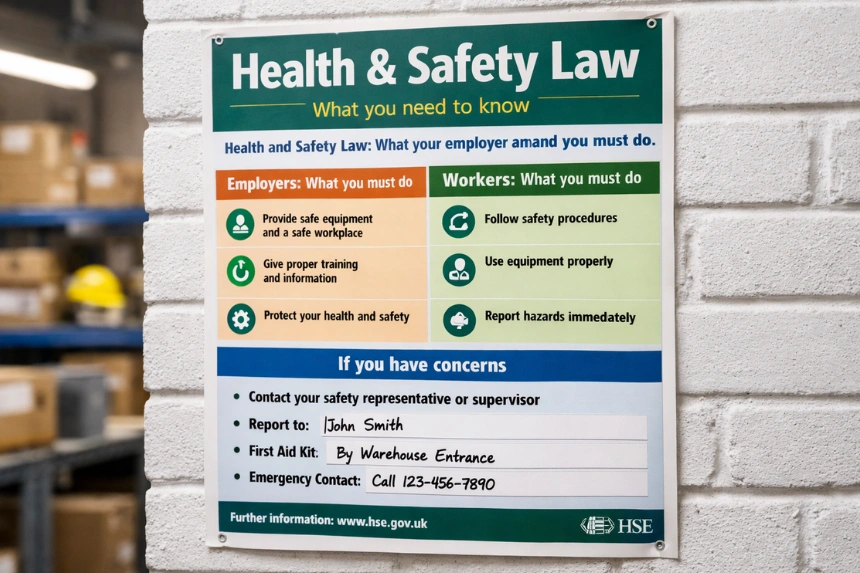
A health and safety law poster is a notice that explains the rules for staying safe at work. It tells what bosses need to do to keep the workplace safe, what workers should do to protect themselves and others, and where to ask for help or report problems. In many places, it is required by law to put this poster where everyone can see it easily so all workers know the safety rules and can follow them.
Health and Safety at Work Act 1974 Poster
The Health and Safety at Work Act 1974 is the main piece of legislation governing workplace health and safety in the UK. To comply with the law, employers are legally required to display a health and safety law poster in the workplace or provide the official leaflet to each employee. This ensures workers are aware of their rights and responsibilities regarding health and safety.
The poster is often referred to as the “HSWA 1974 Poster” or the HSE Health and Safety Law Poster. It contains concise information about:
- The general duty of employers to ensure, as far as reasonably practicable, the health, safety, and welfare of all employees
- Employees’ responsibilities to take reasonable care of their own health and safety and that of others
- How to report unsafe practices or hazards
- Where to find further information or advice, including HSE contact details
Displaying this poster is a legal requirement under Section 2(4) of the Act. Employers who fail to display the poster or provide the leaflet may be subject to enforcement action from the Health and Safety Executive (HSE) or local authorities.
The poster should be placed in a prominent, visible location where employees can easily read it, such as a staff room, noticeboard, or entrance area.
Employer Health and Safety Obligations
Employers carry the main responsibility. It’s not just about having policies, it’s about taking real action to prevent harm.
1. Provide a Safe Working Environment
Employers must keep the workplace safe by making sure floors aren’t slippery, lights are bright, air is clean, and the temperature is comfortable. If someone gets hurt because it’s unsafe, the employer is responsible.
2. Carry Out Risk Assessments
Employers must look for dangers before they cause harm. They check the workplace for hazards like machines or chemicals, figure out who might be at risk, and put risk assessments in place.
3. Provide Safe Equipment and Maintain It
Employers must make sure all tools and machines are safe to use. They need to check them often and fix any problems right away. Broken or unsafe equipment should not be used. Not knowing about a problem is not an excuse.
4. Provide Proper Training and Instructions
Employers must make sure workers know how to work safely, use equipment properly, understand risks, and handle emergencies. If a worker is injured because they weren’t trained well, the employer is responsible.
5. Provide Personal Protective Equipment (PPE)
When risks can’t be removed, employers must give workers the right safety gear like gloves, helmets, goggles, or masks. This gear must be free for workers.
6. Have First Aid and Emergency Plans
Employers must have first aid kits and trained helpers ready. They also need clear emergency exits and fire safety plans. Quick help during emergencies can save lives.
7. Report and Record Incidents
Big accidents must be recorded and reported to the right authorities. Ignoring accidents can cause legal trouble and more accidents later.
8. Consult Employees on Safety
Employers must listen to workers’ safety concerns, ask for their feedback, work with safety reps, and fix reported risks. Workers often spot dangers before managers do.
9. Display Legal Information (Like the Poster)
Employers must put up the health and safety law poster or give out the official leaflet so workers know their rights and duties.
Worker Health and Safety Obligations
1. Take Reasonable Care of Their Own Safety
Workers must act responsibly and avoid careless behavior, such as running in dangerous areas, misusing equipment, or ignoring safety instructions. Failing to do so can make them personally accountable for accidents.
2. Protect the Safety of Others
Employees must ensure their actions do not put others at risk. Leaving tools around or misusing equipment can cause injuries, highlighting that safety is a shared responsibility.
3. Follow Training and Instructions
Workers are required to follow all training and instructions provided, including using machines correctly, wearing PPE, and adhering to procedures. Ignoring training is a serious safety violation.
4. Use Equipment Correctly
Employees must use tools only for their intended purpose, never tamper with safety guards, and report any faults instead of ignoring them, as misuse is a common cause of workplace injuries.
5. Report Hazards and Risks
Workers have a duty to report unsafe conditions, such as damaged wiring, chemical leaks, or unsafe behavior. Staying silent can lead to preventable accidents.
6. Cooperate with the Employer
Safety depends on teamwork. Employees must support employer efforts by attending training, following workplace rules, and participating in safety checks to ensure systems work effectively.
7. Do Not Interfere with Safety Measures
Workers must never remove safety guards, disable alarms, or ignore warning signs. Interfering with safety measures can put lives at risk and may result in disciplinary action.
Poster Sizes and Formats (Including A3)
The health and safety law poster A3 size is the most popular choice because it is clear and easy to read from a distance, making it perfect for notice boards and shared areas.
Smaller A4 posters are also useful, especially in tight spaces or for individual desks, as they are simple to print and place anywhere. In busy areas like entrances or break rooms, large wall posters work best since more people can see them at once.
For workplaces with dust, moisture, or heavy use, laminated or rigid posters are a smart option because they last longer and stay in good condition.
How to Get Health and Safety Poster
1. Go to the Official Source First
The best way to get a health and safety law poster is from an official authority like the Health and Safety Executive. This ensures the poster is accurate, approved, and up to date.
2. If You Want a Free PDF (Be Careful)
If you’re searching for a health and safety law poster free PDF download, only use official government websites. Some provide a free PDF or leaflet you can print, but always check it is the latest and clearly readable.
3. Buying a Printed Poster (Best for Compliance)
A printed poster is the safest option. It is high quality, easy to read, and helps you stay fully compliant without any risk.
4. For Remote Teams or Multiple Locations
For remote workers, send a digital copy through email or your company system and make sure everyone can access it easily.
Example: How a Health and Safety Law Poster Works in Practice
Imagine a small manufacturing company with about 25 employees. The company operates a warehouse where workers handle heavy machinery and equipment. To comply with the law and keep everyone safe, the employer places a health and safety law poster in the main entrance and the break room, so all employees can easily see it when they arrive or take a break.
The poster is the official A3 version from the Health and Safety Executive, ensuring it is accurate and legally approved. The employer fills in local details, including the names of first aiders, emergency contact numbers, the location of first aid kits, and the safety representative. They also date it to show it is current.
Employees use the poster as a quick reference to understand their duties, like wearing protective equipment, following safety procedures, and reporting hazards. The employer also uses it as part of a broader safety system: they conduct regular risk assessments, provide training on machinery, and keep an accident log.
Six months later, the company hires new staff. The employer updates the poster with the new first aider’s name and checks that all contact information is still correct. They also remind employees about the poster during a safety briefing, reinforcing that safety rules are actively monitored, not just displayed on a wall.
Because of this system, employees know exactly who to contact in an emergency, understand their responsibilities, and see that the company takes safety seriously. The poster is not just decoration, it becomes a central part of a working safety culture.
Common Mistakes to Avoid
Many workplaces reduce the effectiveness of the poster by making simple errors. Avoid placing it in hidden corners or behind clutter, using outdated versions, forgetting to fill in local details, printing blurry or low-contrast copies, or leaving damaged or faded posters on the wall. Addressing these small issues ensures the poster remains useful and legally compliant.
Conclusion
A health and safety law poster is more than just a wall notice, it’s a practical tool that keeps employees informed, reminds everyone of their responsibilities, and supports a safe working environment. When displayed correctly, kept up to date, and backed by real safety actions like training, risk assessments, and proper equipment, it becomes an essential part of a workplace safety culture. Simple steps like filling in local details, choosing the right size, and regularly reviewing the poster can make a big difference in preventing accidents and protecting everyone at work.