Understanding EBSNA and Its Impact on School Attendance
Introduction
School absence is rarely straightforward. For a growing number of children and young people in the UK, the inability to attend school is not a matter of truancy or choice, it is the result of profound emotional distress that makes the school environment feel genuinely unsafe. This is the reality of EBSNA: Emotionally Based School Non-Attendance.
As absence rates in English schools reach levels not seen before the pandemic, and as our understanding of child mental health deepens, EBSNA has become one of the most pressing concerns in UK education. Understanding what it is, what causes it, and how to respond effectively is critical for parents, educators, and professionals working with children and young people.
What Is EBSNA?
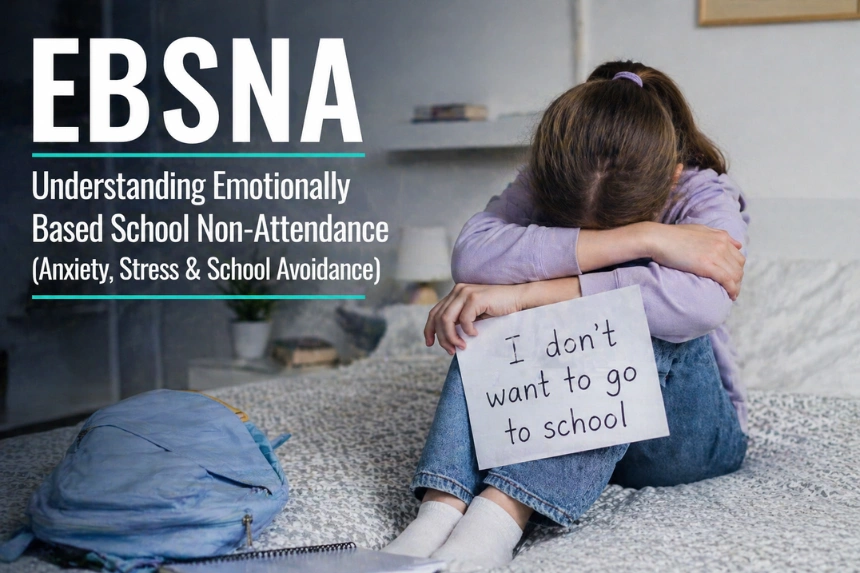
EBSNA stands for Emotionally Based School Non-Attendance. The emotional element of EBSNA is what makes it distinct from other forms of non-attendance such as truancy. It is also not “refusal” to attend, though this term has been used in the past. Often children want to attend school. It is the overwhelming experience of stress, anxiety, and other emotions that make a child feel that they must stay away or avoid school.
The Scale of the Problem in the UK
School absence is a significant cause for concern, with overall absence rates across primary, secondary, and special schools in England for 2023-24 reaching 7.2%.
During the 2022/2023 academic year, the overall absence rate in English schools was 7.5% compared with approximately 5% pre-pandemic, while the rate of persistent absenteeism, defined as missing more than 10% of academic sessions, was 22.3%, approximately double the pre-pandemic rate.
Although overall absence and persistent absence in schools are declining, severe absence is increasing. In 2024-25 the proportion of severely absent students was 2.39%, up from 2.3% in 2023-24. EBSNA is widely understood to be a significant driver of these severe absence figures, even though it is not recorded as a specific category within Department for Education data.
The 2022 Attendance Audit from the Children’s Commissioner found that in Autumn 2021, one in four children were persistently absent. In 2018/2019, this figure was one in nine, meaning that persistent absence has more than doubled in this period.
What Causes EBSNA?
A Combination of Interconnected Factors
EBSNA cannot be pinpointed to one single event, interaction, or reason. It often occurs because of multiple factors and there will have been a build-up, possibly a period of masking from the child or young person, and then one trigger may be the last straw that causes the avalanche of emotions.
Many children with EBSA experience significant anxiety triggered by academic pressures, social challenges, or personal stressors. Environmental stressors within schools, including bullying, inflexible routines, or a lack of understanding about mental health, further exacerbate feelings of distress. These are not factors that children can control, and they highlight the need for systemic support.
Key factors that influence attendance include a sense of school belonging closely linked with feeling safe, the challenge of educational transitions (not only from primary to secondary, but also the challenge of a “second transition” from Year 7 to Year 8), and the complexity of intersecting needs, for example, female pupils who are eligible for pupil premium and have SEND needs are particularly likely to have low attendance.
The Role of Anxiety
Anxiety drives school avoidance by making school feel unsafe, and avoidance becomes a learned coping strategy that reduces distress in the short term but strengthens anxiety over time. When a child avoids attending school, the anxiety immediately decreases and the child feels relief and safety. The brain quickly learns, “Avoiding school makes me feel better,” creating a negative reinforcement loop where avoidance becomes the brain’s solution.
The COVID-19 Factor
Lockdowns at the peak of the COVID-19 pandemic led to extended school closures globally, and in many countries school attendance has not recovered to pre-pandemic levels. The disruption to children and young people’s education caused by containment measures is showing a long-lasting effect on some pupils’ relationship with school.
The COVID-19 pandemic intensified the prevalence of EBSA. Prolonged periods of remote learning, the loss of structured routines, and social isolation left many children feeling anxious and disconnected from traditional schooling. Upon returning to in-person education, some students experienced heightened stress and difficulty reintegrating.
EBSNA and Neurodivergent Children
The connection between EBSNA and neurodivergence is one of the most important, and underappreciated, aspects of this issue.
Many children experiencing emotionally based school avoidance are neurodivergent because neurodivergence often brings heightened anxiety, sensory sensitivities, executive function differences, and social challenges. Neurodivergence increases the risk of EBSA because school environments often overwhelm sensory, social, cognitive, and emotional capacities. When children cannot regulate or cope with these demands, avoiding school becomes a protective strategy.
In a large UK survey, most children experiencing school distress were neurodivergent, with autistic children showing earlier onset and longer duration of distress than other groups. Over 30% of autistic pupils in England are classed as persistent absentees.
For autistic young people, school life becomes cognitively demanding, physically and emotionally draining. Over time, repeated exposure to overwhelming sensory input conditions the brain to associate school with threat, making avoidance a logical and protective outcome.
How to Identify the Signs of EBSNA
EBSA can present as fear, anxiety (including physical symptoms), misery, complaints of feeling ill without obvious cause, reluctance to leave home, delays in following morning routines, difficulties separating from parents or carers on arrival at school, and angry outbursts. In some cases, the avoidance behaviour might result in noticeable patterns of lateness and days absent from school.
The physical signs and symptoms are most pronounced on school days or when school attendance is anticipated and may diminish when the child or young person is allowed to remain at home. This pattern is a key indicator that the distress is emotionally based rather than linked to a physical illness.
It is also important to recognize that EBSNA does not exclusively affect struggling students. High academic potential can contribute to EBSA, because gifted or high-achieving students may experience intense pressure to perform, leading to anxiety, perfectionism, or fear of failure. Academically able students are sometimes assumed to be coping because they achieve well, leading to delayed identification of EBSNA.
The Path Forward: A Collaborative, Systemic Response
Researchers and campaigners argue that the government’s failure to deal with EBSNA stems from seeing it as an attendance problem. Underneath EBSNA lies a layer of corrosive anxiety which can only be helped by releasing the pressure on the children who experience it. Once that pressure is reduced, it creates space where schools and families can work together constructively to support the child.
By asking “can we create an environment where EBSNA doesn’t exist?” schools are already employing many strategies that support children who may experience school-related anxiety. Developing a compassionate, respectful, and anxiety-friendly environment should be a systemic priority, not just an individual response to individual cases.
The evidence is clear: effective support for EBSNA requires close coordination between families, schools, educational psychologists, CAMHS professionals, and local authority services, with the child’s voice and well-being at the center of every decision.
Conclusion
EBSNA represents one of the most complex and consequential challenges facing UK education today. It is not a behaviour problem, a parenting failure, or a simple choice, it is an expression of genuine emotional distress that demands a thoughtful, multi-agency response.
The key takeaways are that early identification matters enormously, that neurodivergent children are disproportionately affected and require tailored support, and that any intervention must be co-produced with the child and their family, not imposed upon them.
If your child is experiencing difficulties attending school, or if you work with children showing signs of EBSNA, connecting with school SENCO teams, local authority educational psychology services, and organizations such as YoungMinds is a meaningful first step.